Piano Is a Year-Round Sport: Making Practice Work When School Starts
Every August, the family calendar gets rewritten. School starts, activities resume, homework returns, and the loose rhythm of summer disappears overnight. In my studio, students play year round, so nobody is dusting off the piano after a two-month break. But the start of school still changes everything about how piano practice fits into the week, and families who handle that transition deliberately have a much better fall than families who let it happen to them.
First, a word about why my studio runs through the summer. It has nothing to do with scheduling convenience. It is how skill-building works. The research on distributed practice is some of the most consistent in all of cognitive science: steady, spaced exposure produces dramatically better long-term retention than the same effort concentrated into bursts. A student who plays continuously through the summer enters September mid-stride, building on June rather than reconstructing it.
Teachers who run seasonal studios spend every September relearning May. My students spend September learning new music. Over a few years, that difference compounds into a level or more of progress. This is the same reason serious athletes do not take entire seasons off. Piano is a year-round sport, and the students who treat it that way are the ones who keep advancing.
In a year-round studio, the back-to-school problem is not lost ground; it is arithmetic. Summer days have hours of unstructured time, and practice can float into any of them. School days do not. Between the school day itself, homework, sports, and dinner, the window for practice shrinks to a sliver, and a sliver that is unguarded gets eaten.
Here is the paradox. Students often practice better during the school year than they do in summer. Summer’s abundance of time invites drift. The school year’s scarcity forces a decision about exactly when practice happens, and a decision, once made, becomes a habit. The families who struggle in the fall are the ones who never made the decision.
The most effective thing you can do in the next two weeks is give practice a fixed address in the daily routine. “Sometime after school” is a wish, not a plan. Give practice a specific anchor: right after the snack and before homework, or right after dinner, or first thing in the morning before the bus. The anchor matters more than the hour. Practice that is attached to something that already happens every day will happen; practice that floats until “later” will not.
The start of school is actually the easiest moment of the whole year to do this, because the entire routine is being rebuilt anyway. A practice slot installed in the first two weeks of school, while the schedule is still wet cement, tends to hold until June. Trying to carve one out in October, against a routine that has already hardened without it, is a much harder fight. I see this every year with families across Clearwater, Dunedin, Palm Harbor, and Safety Harbor: the ones who set the slot in August rarely have to think about it again.
When the practice window shrinks, the quality of what happens inside it has to rise. Fortunately, that is exactly what the research supports. How you practice matters far more than how long, and a focused 15-minute session with a clear goal beats a wandering 40-minute one.
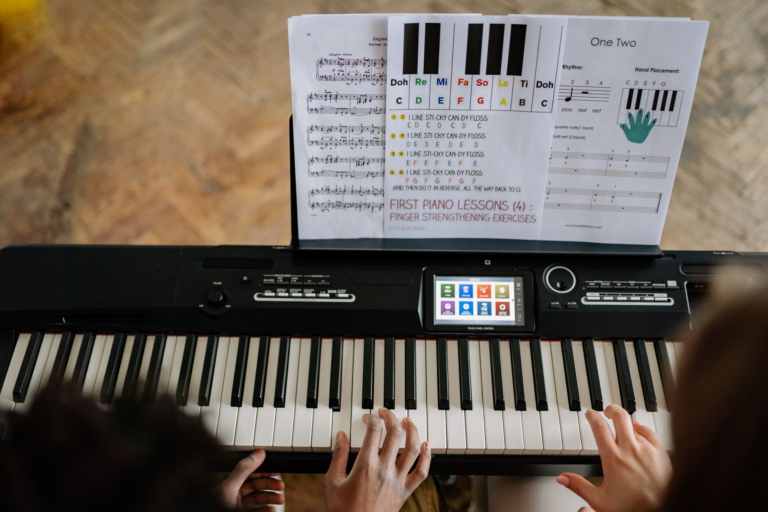
A focused session during the school year looks like this: know before sitting down what the two or three targets are, usually the spots your teacher marked at the last lesson. Go to those spots directly instead of playing the piece from the top and hoping the hard part improves on the way through. Work in short, mixed blocks: a scale, the trouble spot, an older piece, a bit of sight-reading. That variety feels less comfortable than drilling one thing, and the discomfort is the point; switching between tasks forces the brain to retrieve each skill fresh, which is what makes it stick.
For time, the same guidelines apply year round: ten to 15 minutes daily for ages four to six, 15 to 20 for ages seven to ten, 20 to 30 for older students and adults. During the school year, daily consistency at the low end of those ranges beats sporadic sessions at the high end. Five short sessions across the week will always outperform one long Saturday session, because spacing, not volume, is what drives retention.
Your job is the calendar, not the bench. Protect the practice slot the way you would protect a standing appointment, keep the practice space reasonably free of competing screens and noise, and resist the urge to supervise the musical content. When the schedule inevitably collides with a field trip or a late game, move the session earlier or later that same day rather than skipping it; a shortened session preserves the habit, and the habit is the asset.
The Research
The advantage of spaced practice over massed practice is one of the most replicated findings in learning science; a meta-analysis by Cepeda and colleagues covering 254 studies found consistent, substantial retention benefits from distributing practice across days. Research on deliberate practice, formalized by Anders Ericsson, shows that improvement depends on focused work targeting specific weaknesses rather than accumulated repetition. Studies of interleaved practice demonstrate that mixing tasks within a session, though it feels less productive in the moment, produces stronger long-term learning than blocked drilling.
What This Means for Your Practice
Sometime this week, before the school routine hardens, sit down as a family and pick the practice slot: a specific anchor point that happens every day. Write it into the schedule like any other commitment. Then make the sessions themselves smaller and sharper: two or three specific targets, short mixed blocks, daily rather than heroic. If your student played through the summer, they are entering the fall mid-stride; the only thing that can slow them down now is a schedule that never quite found room for the piano. Do not let that be the story of this school year.
Related Reading
The Six-Hour Rule: Why Spacing Your Practice Sessions Matters
Stop Practicing for 30 Minutes. Start Practicing with Purpose.
References
Cepeda, N. J., Pashler, H., Vul, E., Wixted, J. T., & Rohrer, D. (2006). Distributed practice in verbal recall tasks: A review and quantitative synthesis. Psychological Bulletin, 132(3), 354-380.
Ericsson, K. A., Krampe, R. T., & Tesch-Romer, C. (1993). The role of deliberate practice in the acquisition of expert performance. Psychological Review, 100(3), 363-406.
Rohrer, D., & Taylor, K. (2007). The shuffling of mathematics problems improves learning. Instructional Science, 35(6), 481-498.